AI drives
The AI decomposes the problem into computational steps, drawing on a relevant part of the corpus of human mathematical knowledge.
AI is increasingly becoming the driver of computational mathematics in research, engineering, and education, and the trend is accelerating. At the same time, Computer Algebra System (CAS) algorithms rest on formal proofs, which themselves started as inference, and AI models are trained on the products of that formalization. The cycle between inference and certified computation has always been there. ExaktAI’s vision is summarized in four assumptions.
AI is increasingly the driver of computational mathematics. Given a mathematics or physics problem, an AI decomposes it into steps, each one a computation, and reasons to the answer.
AI reasoning is grounded in training on essentially all existing textbooks, research papers, and course materials in digital form. That body of synthesized mathematical knowledge, available to the AI for almost instant recall, will usually surpass the immediate recall of any individual human, though a human could still see what the AI missed.
AI infers mathematical results. CAS computes them by executing deterministic algorithms derived from mathematical proofs. The distinction is not about accuracy, but about what stands behind each result.
A CAS algorithm is a chain of certified transformations, and the algorithm’s correctness rests on the theorems behind it. AI carries no such certificate. More training data only increases the probability of a correct answer. This gap is epistemological, not technological (see AI math reliability). It does not close with scale.
Even formal proof systems (Lean, Rocq) still depend on symbolic computation to differentiate, solve equations, and verify results. Formal proof can strengthen the chain of trust, but it does not eliminate the computational role of CAS.
Without a human in the loop, two things become impossible.
Trust: a person must be able to audit how a result was obtained and judge whether it is sound.
Improvement: a person can see why an approach failed, envision a different one, and contribute mathematical insight beyond any textbook.
Being in the loop is more than approving a result at the end. It means being able to enter the mathematics at any point and take it somewhere else: change an assumption in an equation, recompute it numerically, look at a plot, ask for another form of a result, state a proposition and have Lean check it, and continue the argument.
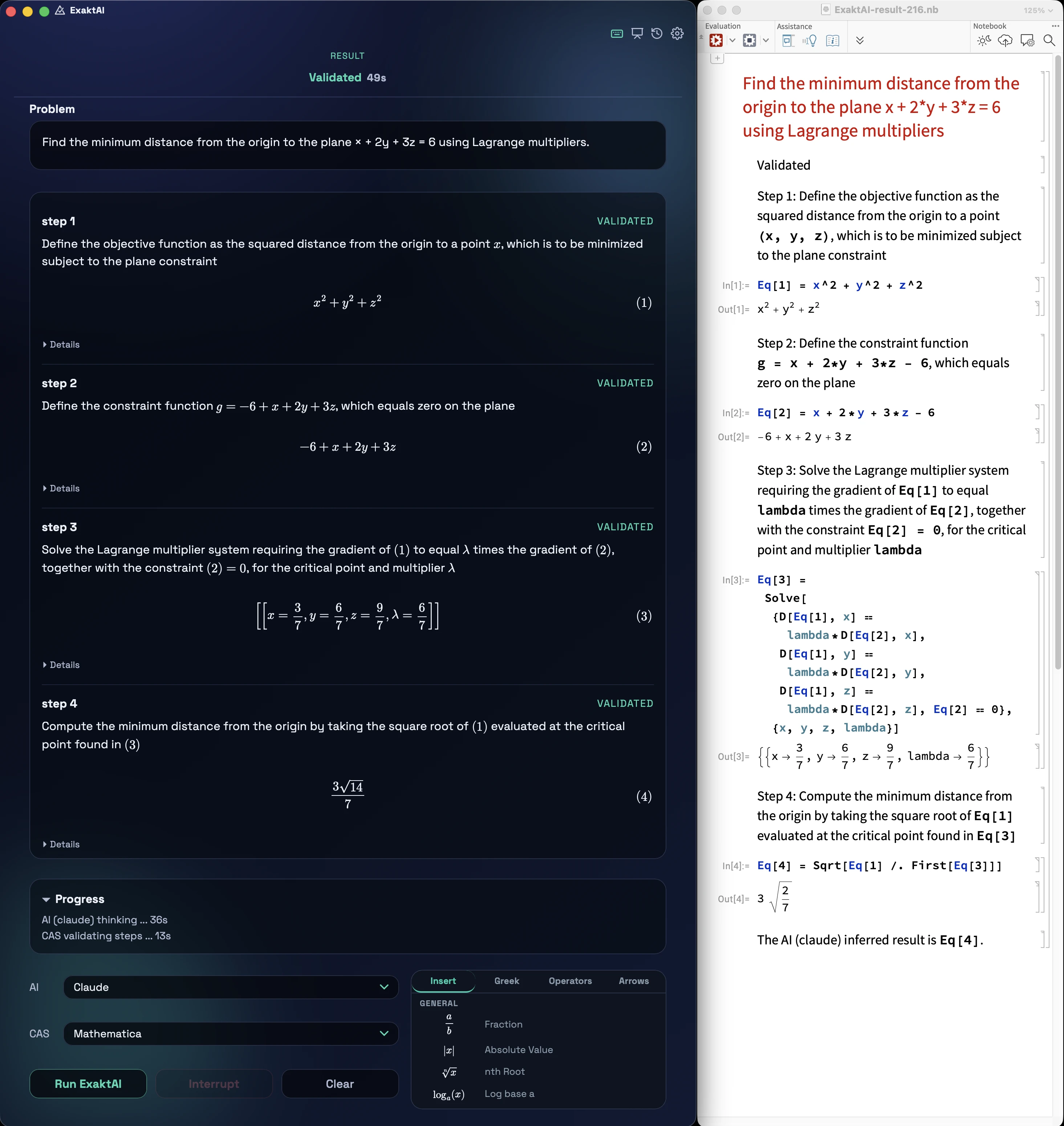
For that, ExaktAI shows each step in its own App with its validation status and details, and generates and opens an executable document, a Maple document, a Mathematica notebook or an ExaktAI Workspace document, in which the mathematics is computation a person can run, change and continue.
In ExaktAI Validation: each step shown with its validation status, alongside the generated Mathematica document a person can audit and extend (Claude + Mathematica).
Reading a solved problem is not the same as solving it. Mathematical understanding comes from active engagement: modifying a step, testing an alternative, and in that process deepening one’s understanding of the problem.
This active engagement is also supported by the executable CAS documents that are automatically generated and opened when ExaktAI produces a result. A CAS document is a starting point where every step can be re-executed, every result modified, and the problem studied and its solution developed using different approaches.
The same holds for learning the computational systems themselves. The Workspace includes introductions to SymPy, NumPy, SciPy, Matplotlib, Maple, Mathematica, MATLAB and Lean that start from paper and pencil: each section shows a computation as it is done on paper, then the same computation in the system, in a document that runs as you read it, with exercises and their solutions.
The AI decomposes the problem into computational steps, drawing on a relevant part of the corpus of human mathematical knowledge.
Each step is executed by a CAS whose algorithms carry into computation the certificate of correctness established by the formal proofs behind them.
The person inspects, experiments, and improves, generating trust and progress: corrections or reformulations become possible.
The executable document is where active mathematical work happens and understanding is built.
AI will continue to improve. The gap between probabilistic inference and certified computation, however, is not technological but epistemological, and as such it will not disappear with more training data. As AI takes on harder problems, it demands more from CAS: more algorithms, broader coverage, and deeper formalization in order to certify results and produce new training data. The more AI evolves, the more CAS matters.
ExaktAI is built with this evolving landscape in mind.