The unsolved problem is not whether AI can do mathematics. It can: state a problem,
and AI proposes an approach and works through the steps.
The problem is that an incorrect result can suddenly arrive with the same
confidence as a correct one. ExaktAI addresses that gap, validating AI mathematical
results in a way you can reproduce, not blindly accept. Each AI solution is delivered
with its computations validated, in an automatically generated document: a Maple
document, a Mathematica notebook, or an ExaktAI Workspace document, where the validation using SymPy does not require a commercial Computer Algebra System (CAS) licence.
Two products, one architecture
ExaktAI Workspace
A computer algebra environment where the notation you write and the engine that
computes are separate settings. SymPy, NumPy, SciPy and Matplotlib are inside the
Workspace; Maple and Mathematica are the copies you own; Maple worksheets, Mathematica notebooks, Jupyter notebooks and Python
scripts open natively, with no vendor software installed. The Workspace →
ExaktAI Validation
AI drives the mathematics, one or more computer algebra systems execute every
step, and convergence is what makes a result trustworthy. Each validated solution
arrives as a document you can audit and re-run: a Maple document, a Mathematica
notebook, or an ExaktAI Workspace
document. How validation works →
The ExaktAI App
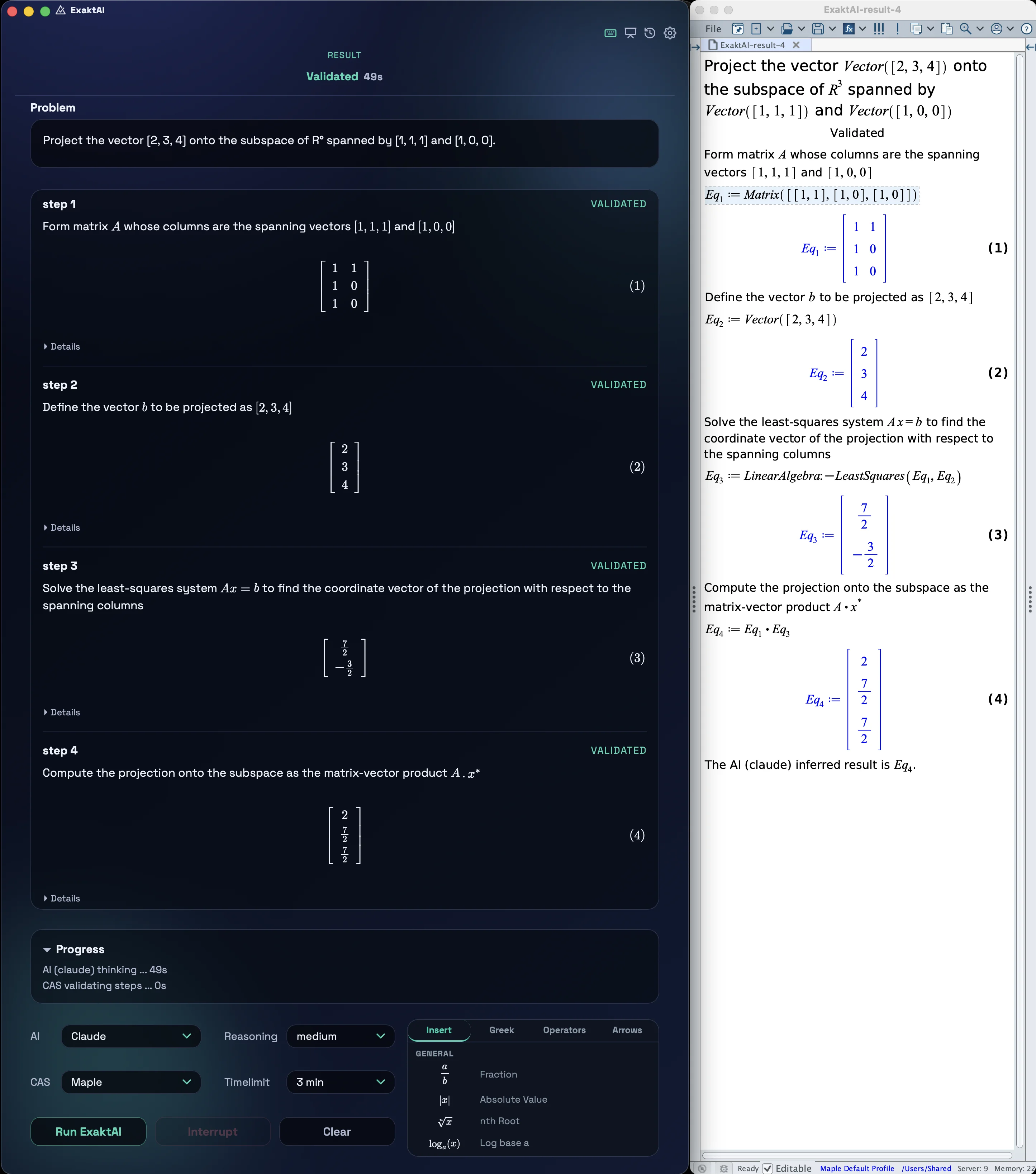
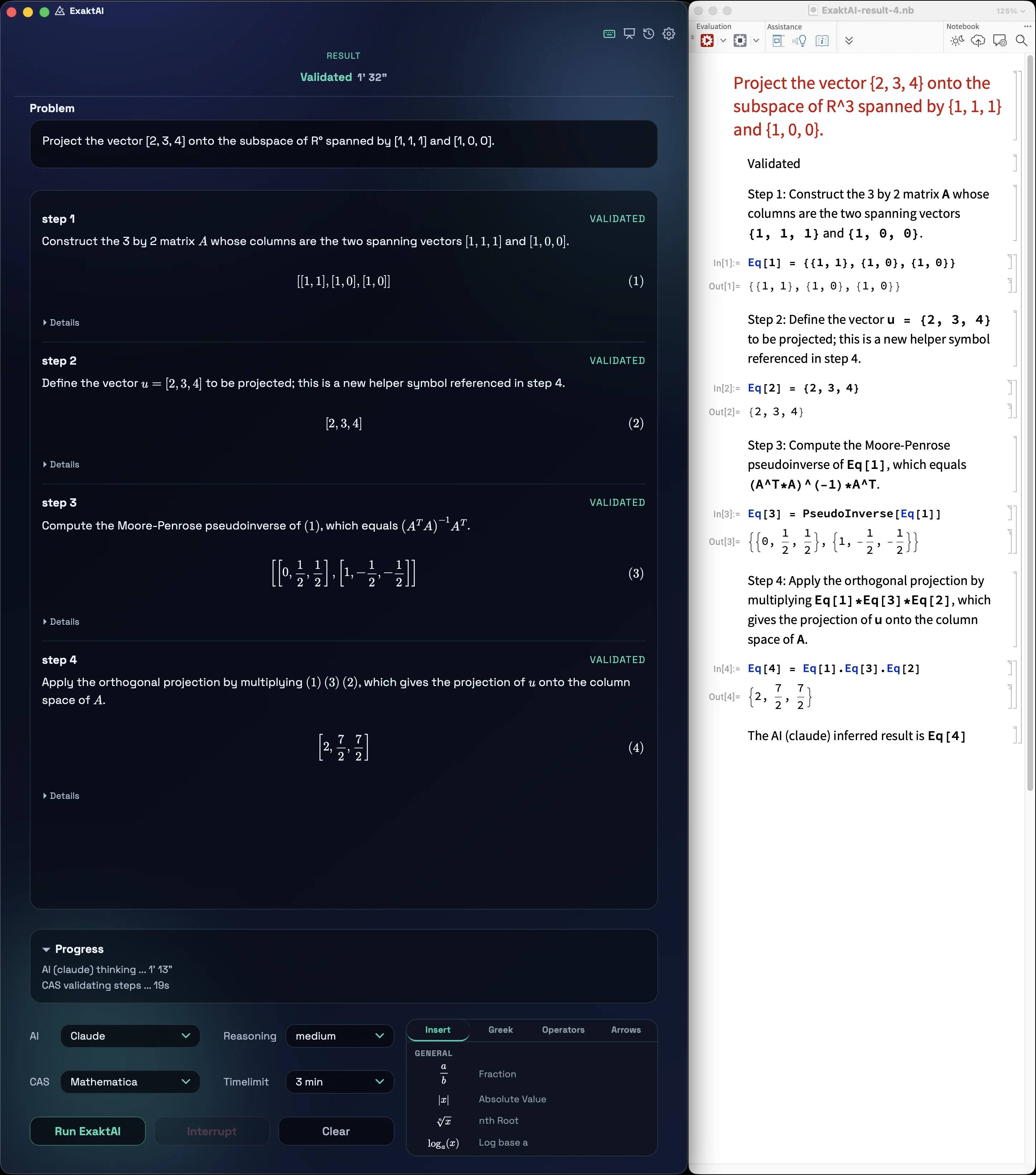
Claude + Maple: a vector projected onto a subspace, validated step by step via Maple's LeastSquares. The document is generated, filled with the CAS results, and opened automatically.Claude + Mathematica: the same problem via Mathematica's PseudoInverse, a different command reaching the same validated result.
The same problem again, validated with SymPy as the CAS, which is
included in the ExaktAI application. Its document opens as an
ExaktAI Workspace document,
live and editable beside the App. The left panel is the App in
Presentation mode, which omits the interface around the mathematics.
Claude + SymPy. The App in Presentation mode on the left, and on the right the ExaktAI Workspace document it generated and opened, where every step is an executable instruction carrying its own validated result: Eq[1], Eq[2], Eq[3].
Six AIs split on this problem when asked for the solution in one go. Through ExaktAI, it is solved and validated in three different ways, on three CAS backends, and the third of them, SymPy, needs no commercial CAS licence. The goal of ExaktAI is to blend AI and Computer Algebra Systems into a process where AI mathematical results are not just generated but also step by step validated, and the validation can be audited.
Three pillars
Validate
Results are validated step by step: AI drives the computation, one or more CAS execute it, and convergence of results is what makes a result trustworthy.
Collaborate
AI drives, CAS executes, and you steer. Each result, with all its steps, appears automatically in a document you can audit, modify, experiment, and extend: a Maple document, a Mathematica notebook, or an ExaktAI Workspace document computed with SymPy.
Expand
The same architecture extends to new problem domains: each addition expands the kinds of mathematical problems whose solutions can be validated and documented.
Project
Project lead
Edgardo Cheb-Terrab, PhD, Theoretical Physics. 28 years at Maplesoft until the end of 2024. LinkedIn →Software portfolio →

![ExaktAI validating the projection problem with SymPy: on the left the ExaktAI App in presentation mode, the problem marked Validated and its steps shown as typeset mathematics; on the right the ExaktAI Workspace document it generated, each step an executable SymPy instruction labelled Eq[1], Eq[2], Eq[3] with its computed result](./assets/images/aii-projection-claude-sympy-workspace-stacked.webp)