ExaktAI uses AI
Claude, Gemini, and other AI systems provide the mathematical reasoning. ExaktAI’s context structures that reasoning into a sequence of declared steps, each one independently checkable.

An AI assistant inside a Computer Algebra System (CAS) document is not the same thing as AI whose reasoning is turned into an executable CAS document with the computational steps validated.
ExaktAI is AI-first. You ask a mathematical question in ExaktAI Validation. Every step of the AI’s reasoning is translated into an executable computational instruction for the chosen CAS (Maple, Mathematica, or the bundled SymPy), executed and validated. Then the CAS document is automatically generated and opened. This CAS document is where you can interact with the solving process step by step: inspect, reproduce, modify, experiment.
Wolfram’s Notebook Assistant and Maple’s AI Assistant are CAS-first. The notebook or worksheet is the environment the user was already working in; the AI sits beside it as an assistant, helping the Mathematica or Maple user understand topics or how to solve a problem. On request, the system attempts to translate the AI’s reasoning into Mathematica or Maple input that is not automatically executed; its result is not validated, it may contain syntactic or mathematical errors, and it often does not include all the steps. Correctness is the user's responsibility to verify, as the CAS FAQs state.
In summary: ExaktAI delivers a validated solution with a CAS document where the solution can be reproduced step by step; in the runs below, the CAS AI assistants delivered a solving narrative, with computational instructions that are not run automatically. For a more challenging comparison, see ExaktAI on a problem by Euler →
The problem tackled with ExaktAI: Claude as the AI and Mathematica as the CAS backend. ExaktAI’s reasoning context guides Claude through a structured decomposition; each step is executed by Mathematica, and Claude’s inferred result is validated against that computation.
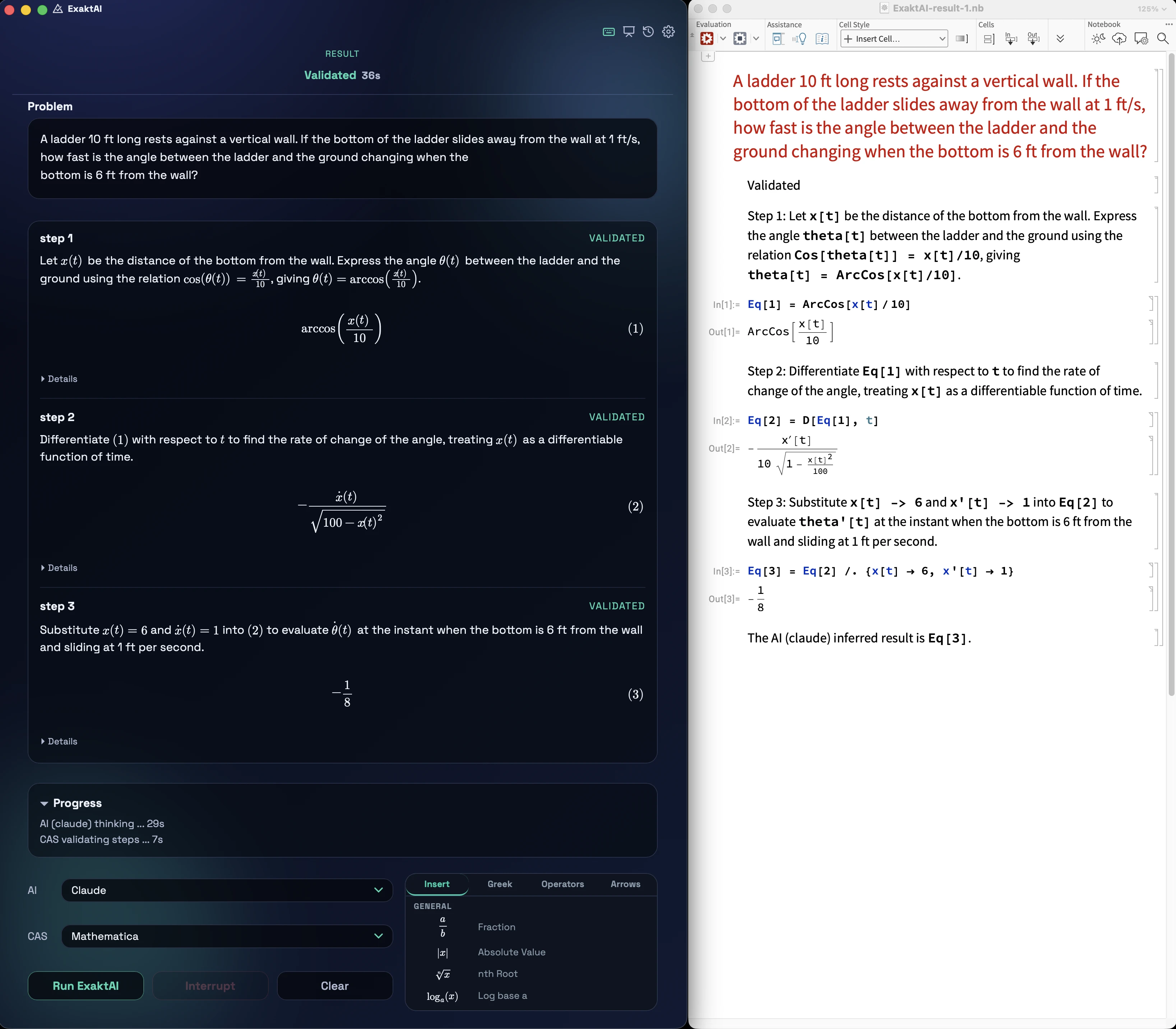
Three validated steps, result: −1/8 rad/s. The Mathematica notebook is the auditable validation document.
Wolfram (Mathematica) 14.1 is one of the world’s most capable computer algebra systems. Its Notebook Assistant combines an AI narrative with a Wolfram Language evaluator and different ‘personas’ for the AI. The AI model used is ‘Wolfram’, the default in Wolfram (Mathematica) 14.1.
Selecting Code Assistant as the ‘persona’, the AI assistant presented an AI narrative followed by one evaluator section. The evaluator generated a code block covering three sections: computing y from the Pythagorean theorem, computing dy/dt, and solving for dθ/dt. Clicking “Insert and evaluate” inserts the block into the notebook and evaluates it.
![Mathematica AI-Assistant (Example 1).nb: top half shows AI narrative with evaluator (Interpreted tab) and output {{θ'[t] → -1/8}}; bottom half shows the inserted notebook cell, Solve::ivar warning, Solve[False, 0], and final output {{θ'[t] → -1/8}}](./assets/images/comparison-WolframCodeAssistant-full-2026-04-05.webp)
The inserted and automatically evaluated code shows Out[8] = Solve[False, 0]
followed by Out[11] = {{θ′[t] → −1/8}}.
How the computation goes from Solve[False, 0] to the correct result is not shown.
The closing conclusion reads: “the rate…
is approximately −1/8 radians per second.” The correct answer
is exactly −1/8, not approximately. No assertion about
correctness is presented.
A second session using the Code Writer ‘persona’ instead of Code Assistant, same AI default model ‘Wolfram’, produced a different evaluator output:
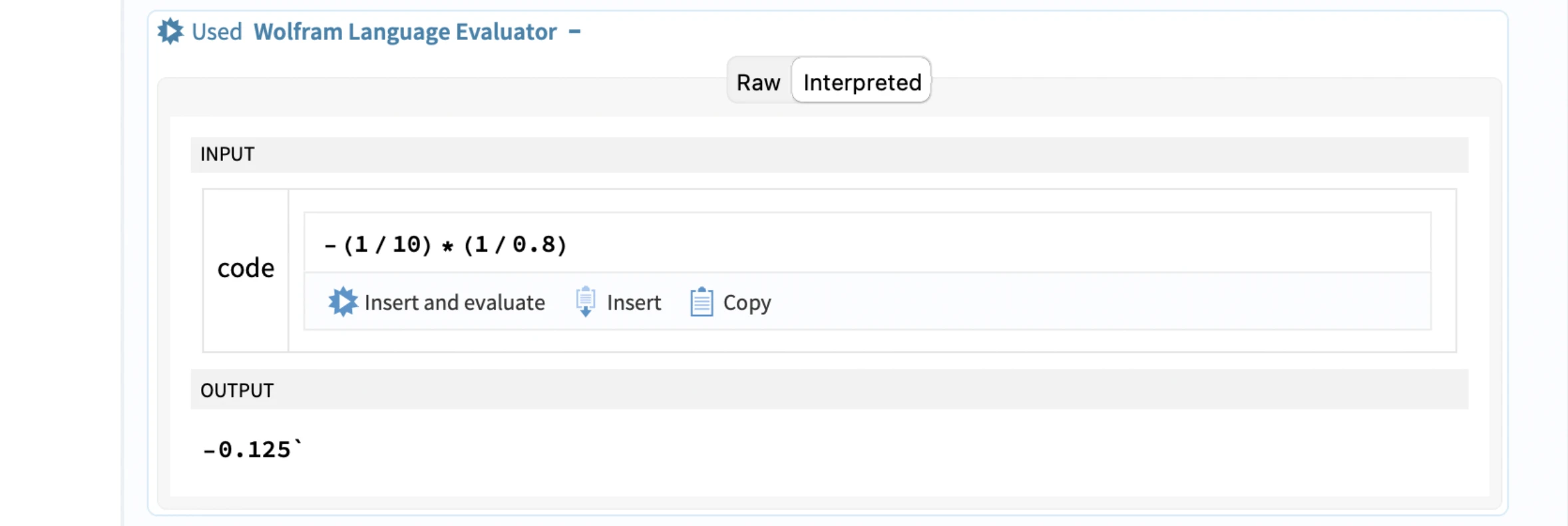
−(1/10) * (1/0.8). Output: −0.125.The code block presented by the Code Writer is a single multiplication, and no Mathematica code is presented for the symbolic steps mentioned in the AI narrative for the problem: the Pythagorean step, the differentiation, or the substitution that produced sin(θ) = 8/10. No assertion about correctness is presented.
The same problem. ExaktAI with Gemini as the AI and Maple as the CAS backend. ExaktAI’s reasoning context guides Gemini through a structured decomposition; each step is executed by Maple, and Gemini’s inferred result is validated against that computation.
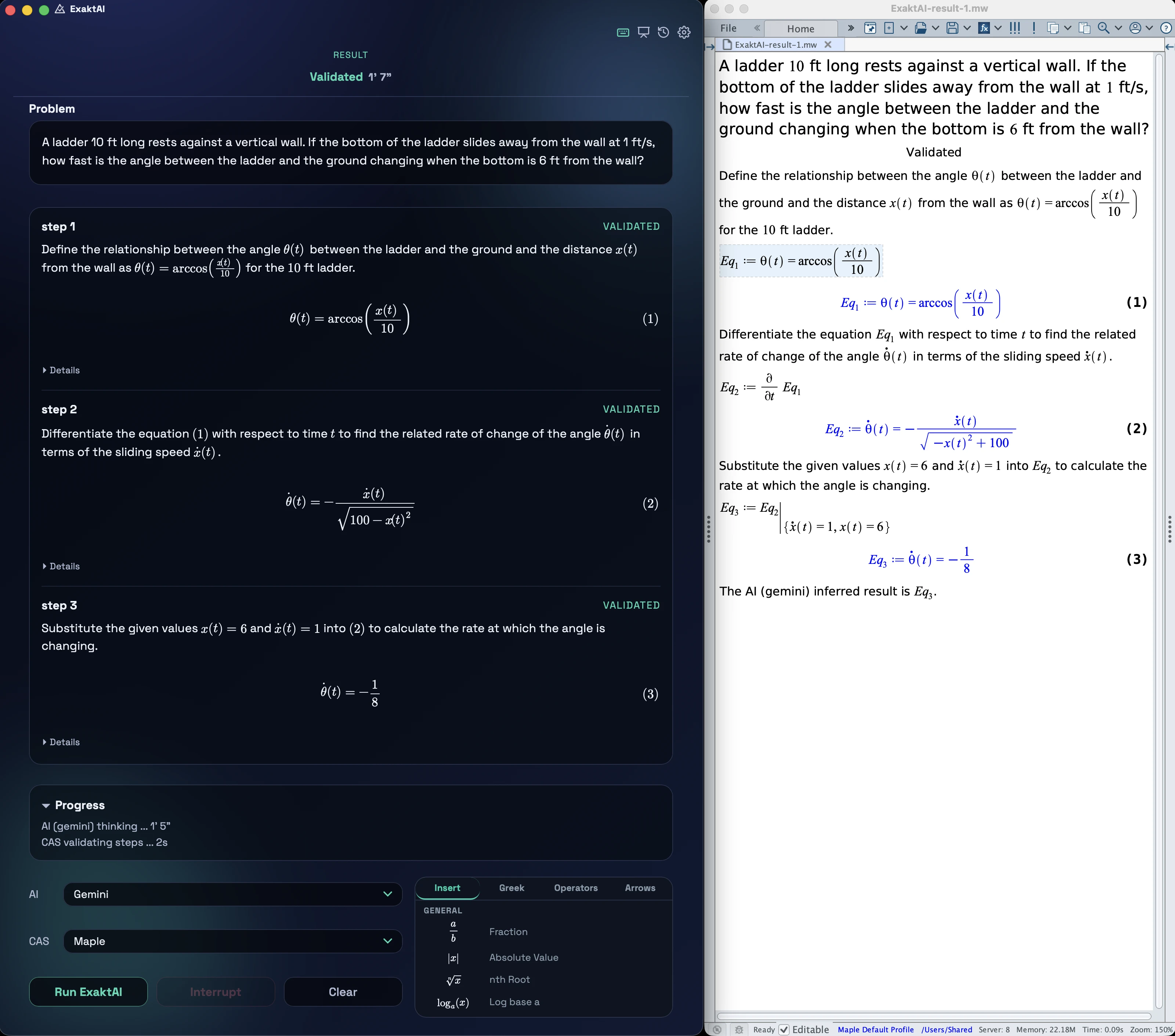
Each step validated. Result: −1/8 rad/s.
Maple is one of the world’s most capable computer algebra systems. Its built-in AI Assistant presented the AI narrative, a plausible solution to the ladder problem. The AI output was then inserted into the Maple document by clicking the last icon below the formula, then pressing enter to evaluate it.
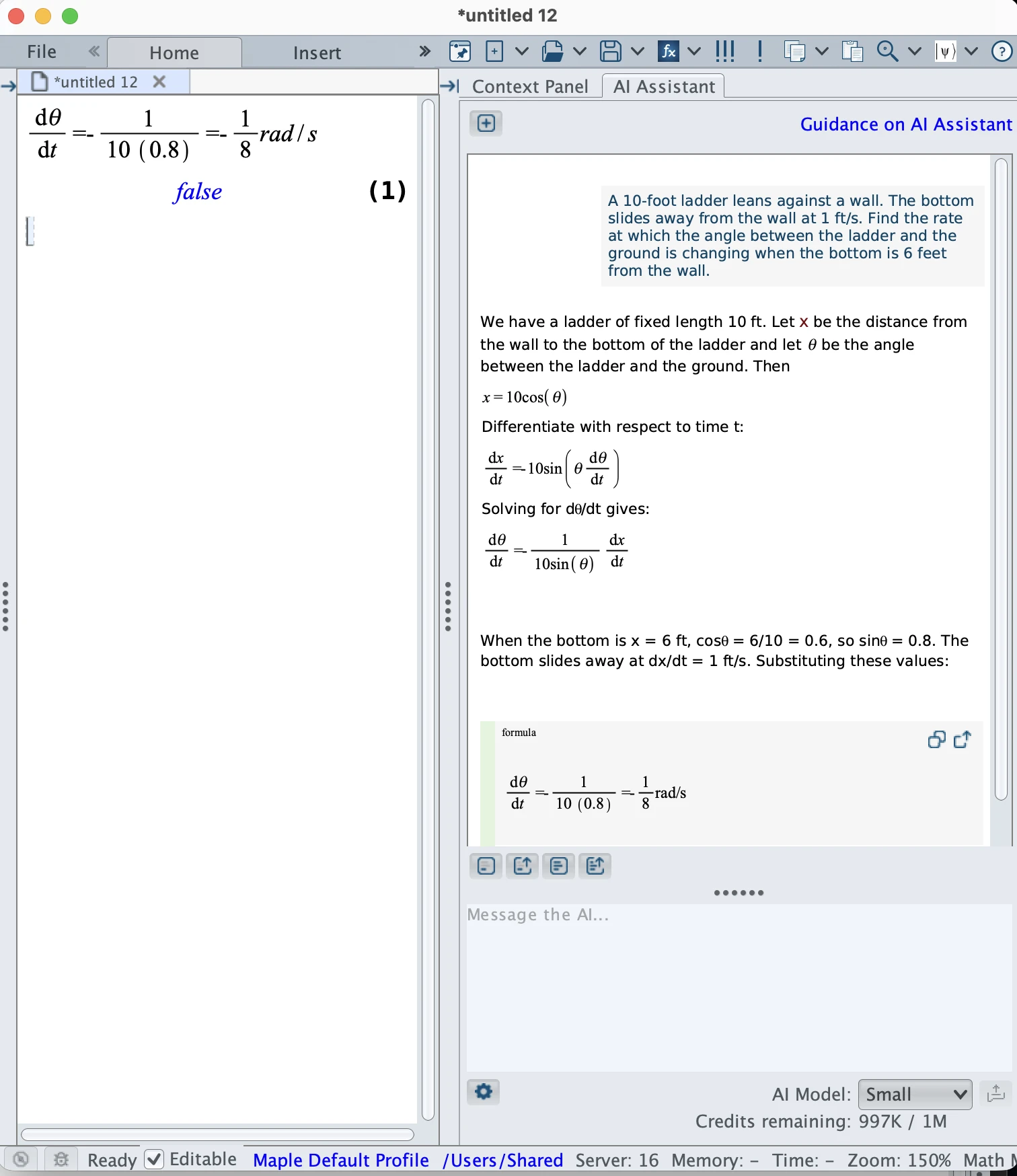
The AI narrative is complete, but Maple’s AI Assistant produced only one formula for the last step, which when inserted and evaluated returned an unexpected ‘false’ instead of the result.
The same problem once more, with DeepSeek as the AI and SymPy as the CAS. SymPy is included in ExaktAI. The validated solution opens as an editable document in the ExaktAI Workspace, where each step is an executable instruction carrying its own result.

Each step validated. Result: −1/8 rad/s.
| System | Displays AI output | All steps as CAS instructions | Result validated |
|---|---|---|---|
| Wolfram Notebook AI Assistant | Yes | No | No |
| Maple AI Assistant | Yes | No | No |
| ExaktAI + Mathematica, Maple or SymPy | Yes | Yes | Yes |
All systems display a narrative produced by an AI. For this particular problem, no system other than ExaktAI succeeded in presenting all steps as CAS instructions, and ExaktAI was the only one that validated the results: on Mathematica, on Maple, and on SymPy.*
Mapping all the AI reasoned steps into a chained sequence of CAS computations, reproducibility, and validation are what set ExaktAI apart from CAS with AI Assistants, and are the basis for you to be in command of the computation, harness AI’s mathematical inference, and trust its results.
In one run of the ladder problem above, DeepSeek produced a complete, well-structured derivation, but inferred the wrong final result: dθ/dt = −1/10 rad/s. The deeper issue is that, in higher mathematics, capable AI systems can return different mathematical answers† depending on how the problem is presented, whether the same request is repeated, or which AI is asked. For a systematic benchmark documenting the reliability problem, see AI math reliability.
Claude, Gemini, and other AI systems provide the mathematical reasoning. ExaktAI’s context structures that reasoning into a sequence of declared steps, each one independently checkable.
Mathematica, Maple and SymPy execute every step and provide a computational ground truth.
Each AI step is validated against the CAS result. The validation is explicit and auditable.
Not a smarter AI. Not a faster CAS. A validated, executable, editable document, where you can audit, reproduce, modify or extend the computation.
ExaktAI Validation is up and running. Its Beta is scheduled for October 15, 2026. Sign up, and we write to you when it opens.
Your address is used only to write to you about the Beta. Privacy policy →
* These runs were performed in April 2026 and used Wolfram (Mathematica) 14.1 and Maple 2026.0. Both software platforms and their AI assistants are actively evolving, and AI narratives vary from run to run; later versions, and other runs, may behave differently. The observations on this page describe what each system produced in these specific runs, and are not a general claim about the products’ capabilities. ↩ ↩ ↩ ↩
† From Wolfram’s documentation, on whether its Notebook Assistant always gives the same answer: “No. It makes use of LLM technology that includes some ‘creative randomness.’” Wolfram Notebook Assistant + LLM Kit FAQ, June 2026. ↩