ExaktAI Validation
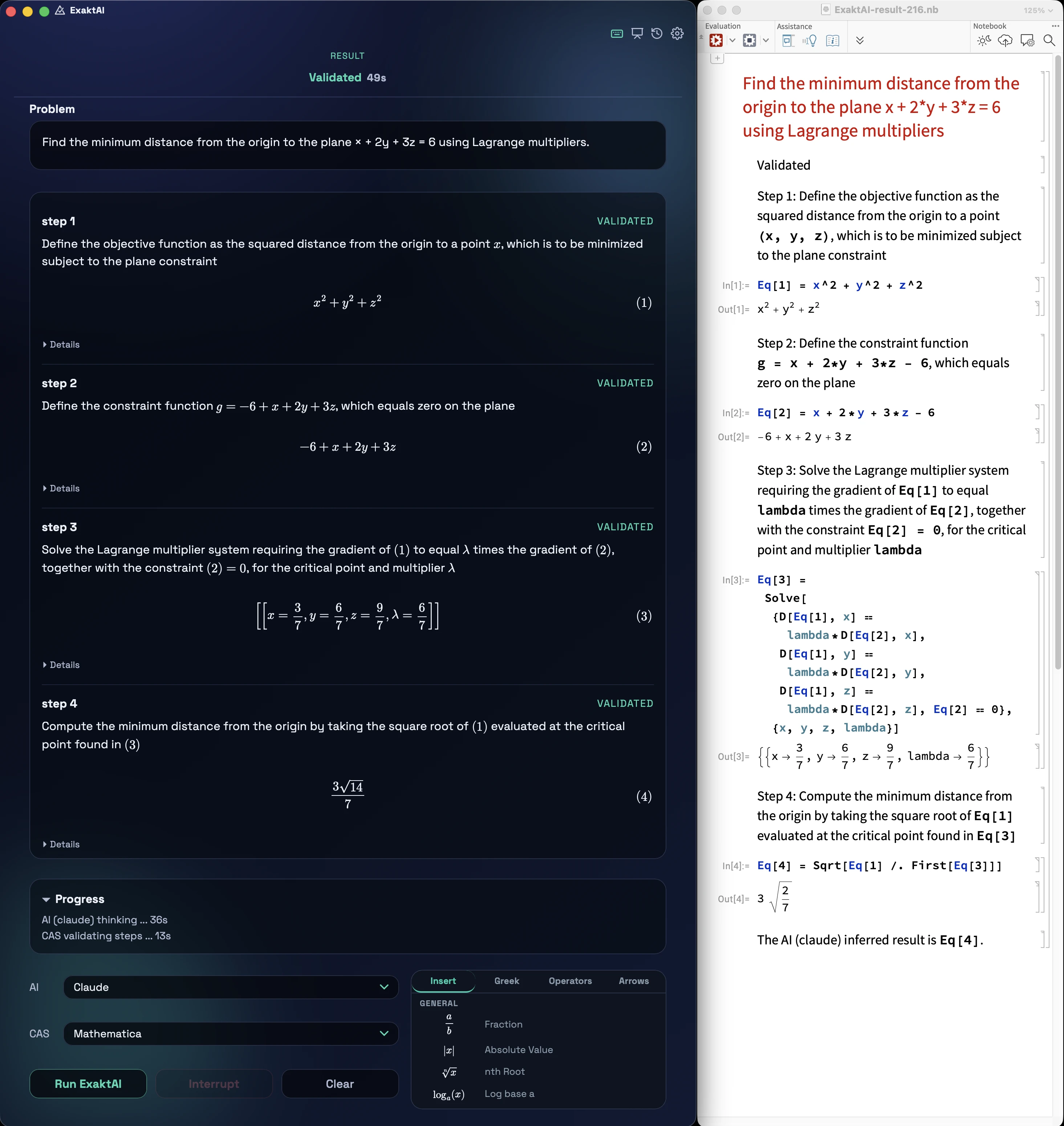
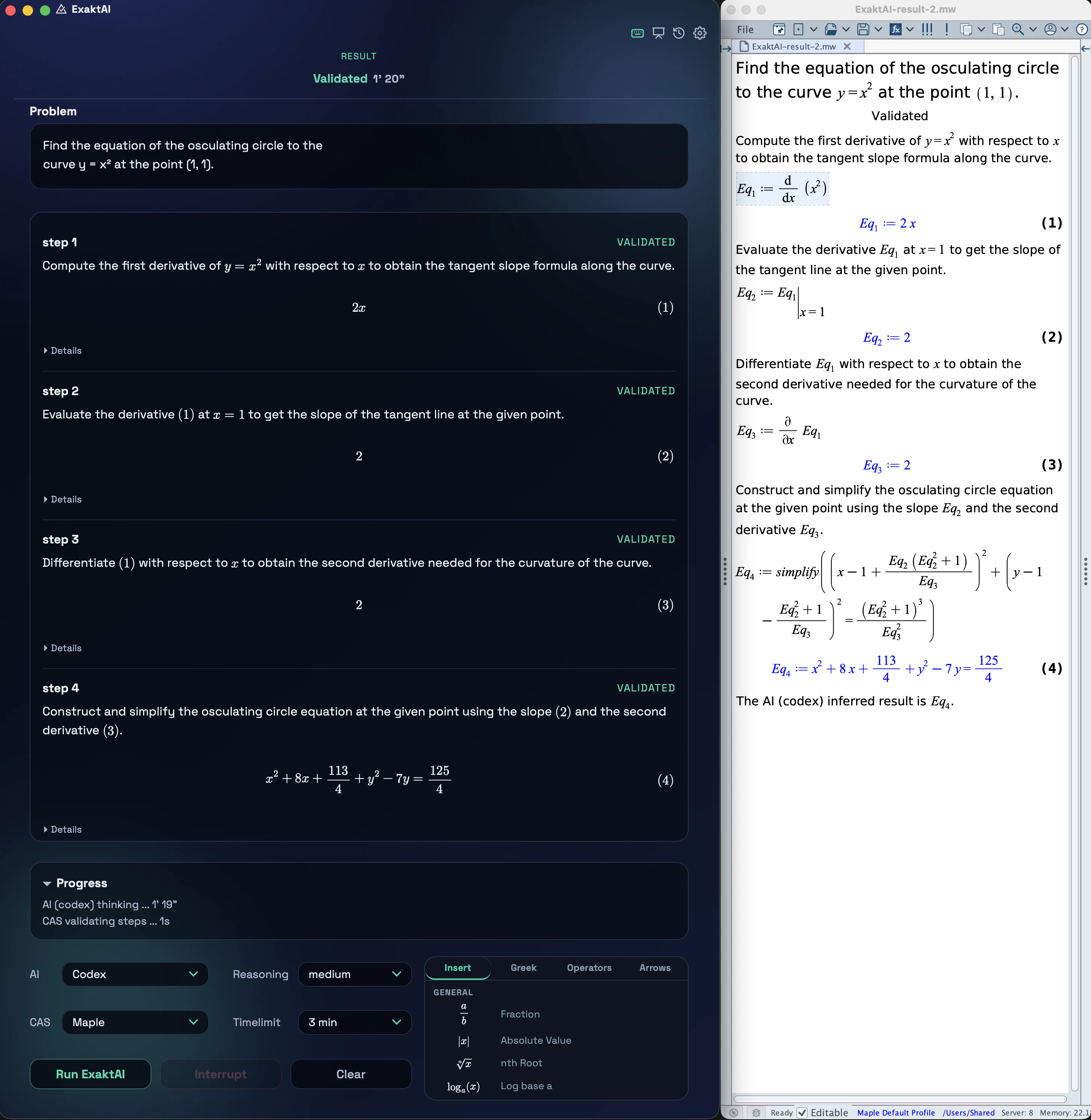
You ask in natural language (English, French, …, Chinese, …), with palettes of mathematical symbols, or in SymPy, Mathematica or Maple syntax. ExaktAI answers with the derivation steps and opens the validation document automatically: a Maple document, a Mathematica notebook, or an editable ExaktAI Workspace document computed with SymPy.
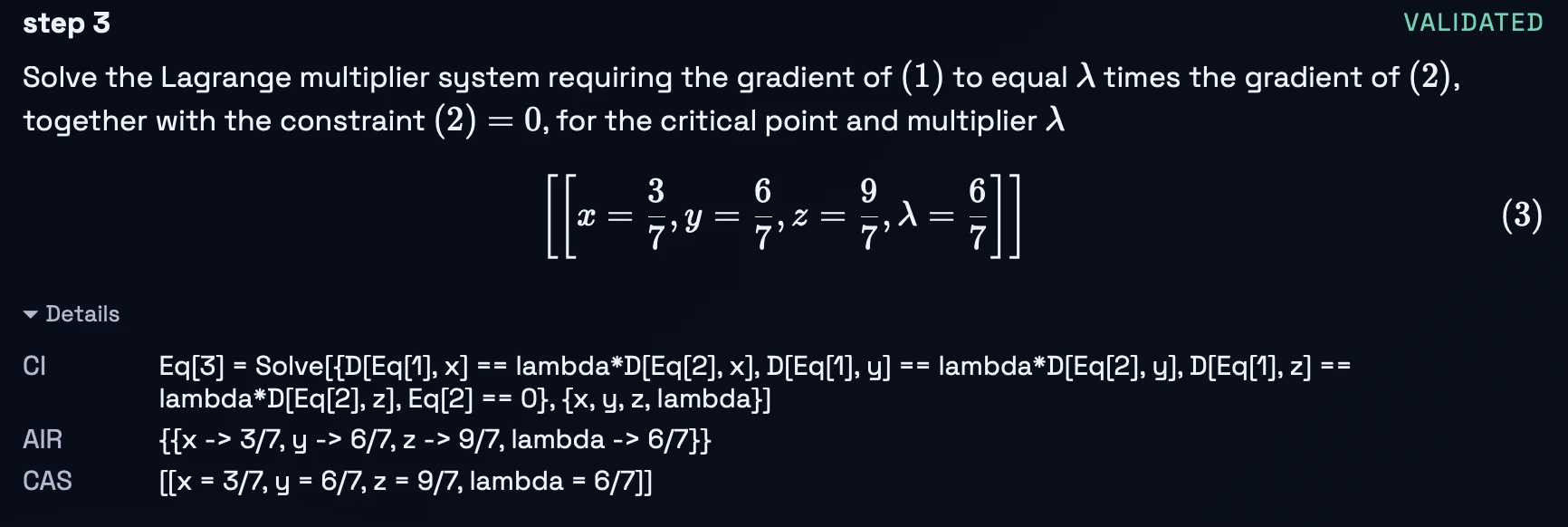
Expanding any of the collapsed 'Details' shows, directly in the App, the computational instruction (CI) that represents the step in the Computer Algebra System (CAS), in this case Mathematica, the AI inferred result (AIR), and the result from the CAS. The CI and CAS are reproduced in the Mathematica notebook.

How it works
The problem is presented using natural language; ExaktAI guides the AI through a structured reasoning process that produces step-by-step computational instructions. Each instruction is executed in a CAS. ExaktAI applies a multi-stage strategy involving independent AIs, CAS executions, and mathematical equivalence checks in order to validate a step.
The document that opens is yours to audit, modify, experiment with and extend.
In summary: ExaktAI orchestrates, AI drives, CAS executes, and you stay in the loop.
AI consensus
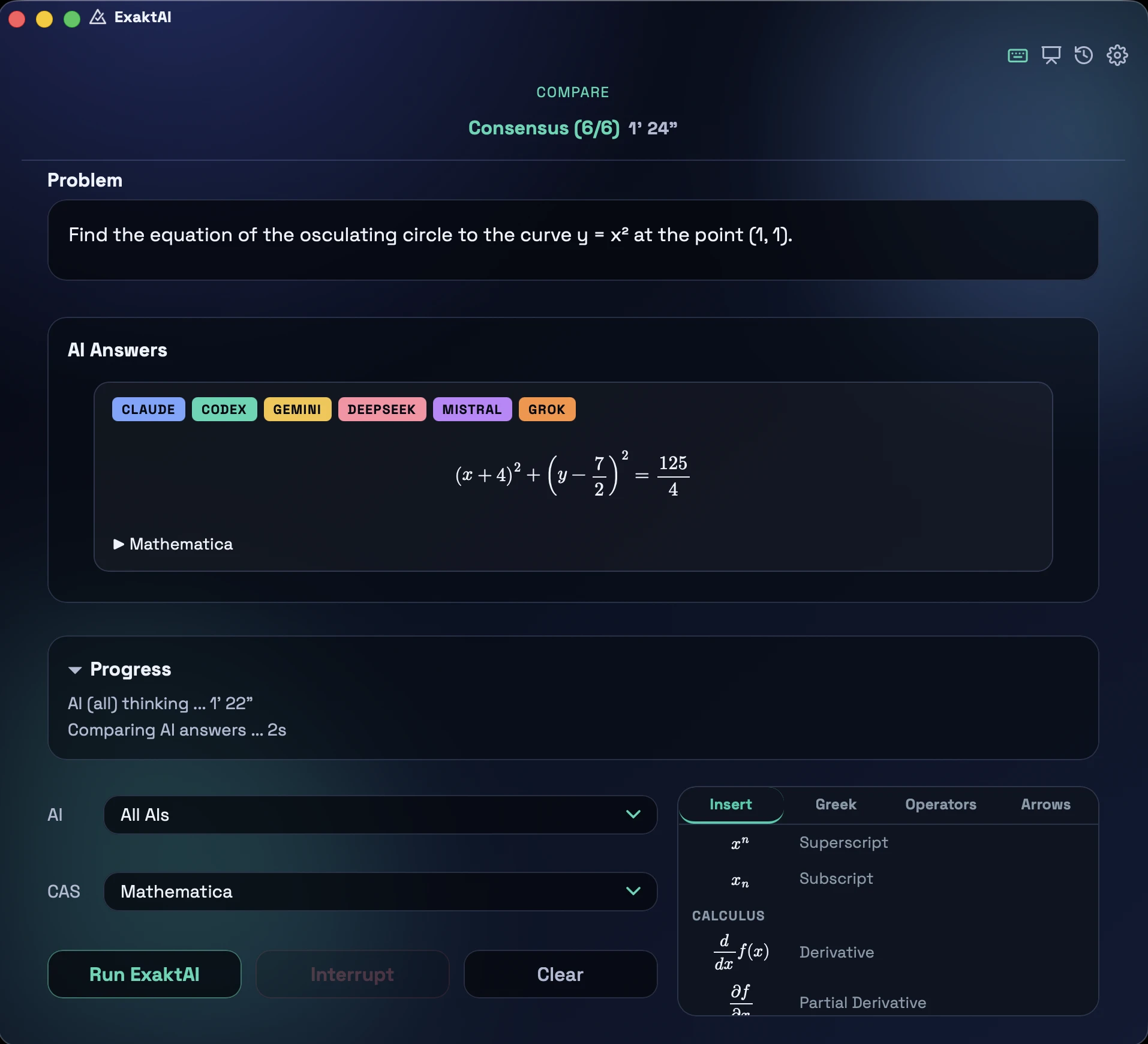
Besides step-by-step validation, there is another mode: run several AIs on the same problem, then verify whether their answers are mathematically equivalent. ExaktAI uses computer algebra systems (CAS) to check equivalence and reports the agreement level, for example, Consensus 6/6 when six AIs independently converge on the same answer, and so on.
Consensus is not a substitute for full step-by-step validation. AI systems sharing the same training data can converge on the same wrong answer. What consensus adds is another way to assess an answer: disagreement is surfaced immediately, and convergence across independent AIs is a meaningful signal.
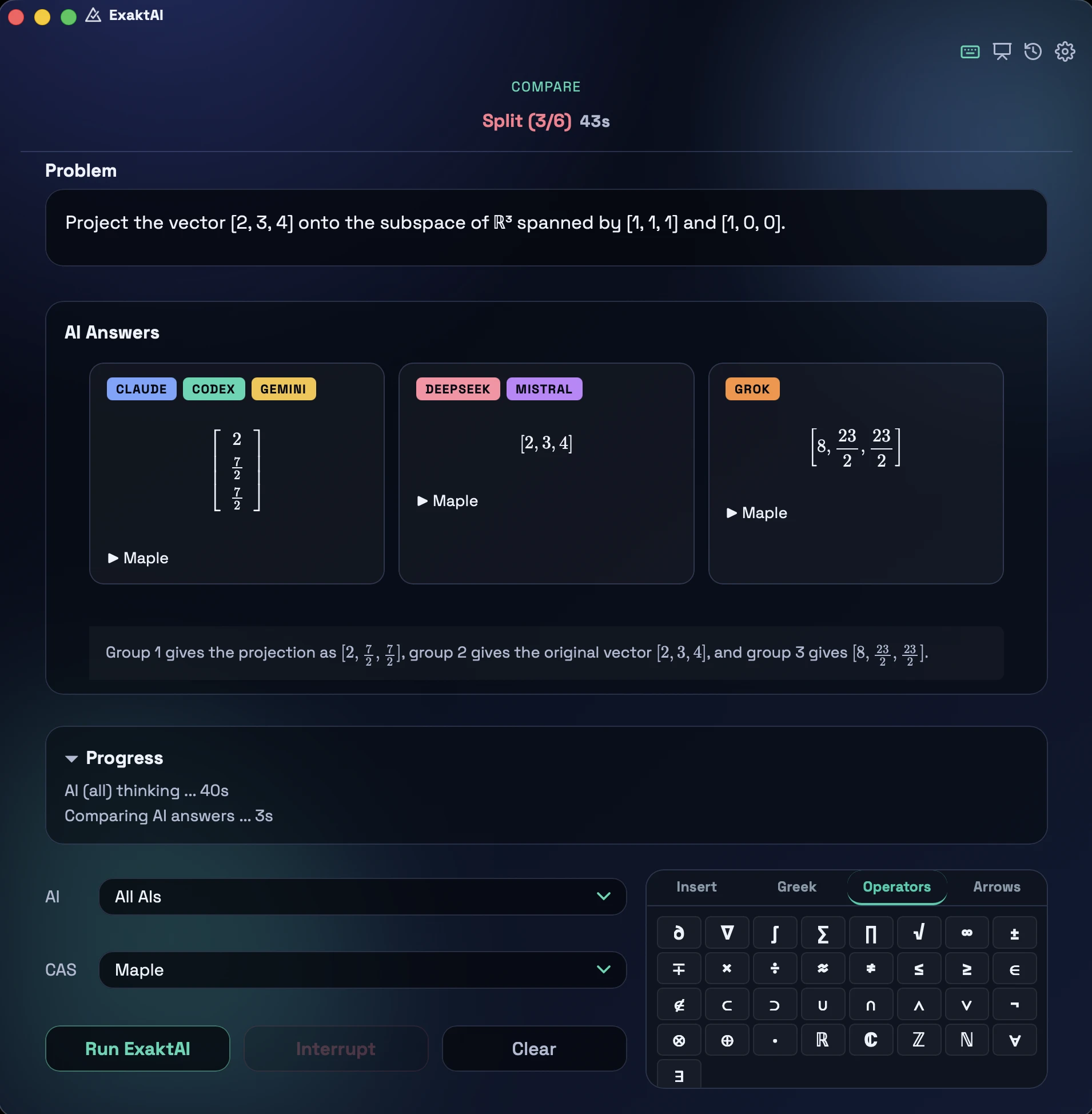
When AIs disagree
Consensus is not guaranteed. When the AIs split, ExaktAI shows which ones agree and explains the difference - automatically, by comparing the actual answers.
For a more challenging derivation, see ExaktAI vs CAS AI assistants on a problem by Euler.
Sign up for the Beta
ExaktAI Validation is up and running. Its Beta is scheduled for October 15, 2026. Sign up, and we write to you when it opens.
Your address is used only to write to you about the Beta. Privacy policy →