
A derivation around a problem by Euler
The problem
“Consider the system of equations a + b + c = u², ab + bc + ca = v², abc = w², and derive, step by step, the parametrized solution [a, b, c, u, v, w] = [k²t²(s²−t²)²(s²+t²), k²s²(s²−t²)²(s²+t²), 4k²s⁴t⁴, k(s⁴+t⁴), k²st(s²+t²)(s⁴−t⁴), 2k³s³t³(s²−t²)²(s²+t²)]. I want to understand how one arrives at it.”
The underlying problem, first considered by Euler, was about finding “Three integers whose sum, product and the sum of the products of the integers, taken two at a time, are perfect squares”. What follows shows how ExaktAI handles the stated problem, and contrasts this with how the AI assistants in Wolfram 14.3 and Maple 2026.1 handle the same problem.
ExaktAI: a validated and reproducible derivation
The problem tackled with ExaktAI: Codex as the AI and Mathematica 14.3 as the Computer Algebra System (CAS) validating tool. The left panel is ExaktAI Validation in Presentation mode, an optional frameless display omitting visual distractions such as the Run ExaktAI button that ran the computation. This mode presents all eight validated steps in a single screenshot. To the right is the Mathematica notebook automatically generated and opened by ExaktAI Validation.
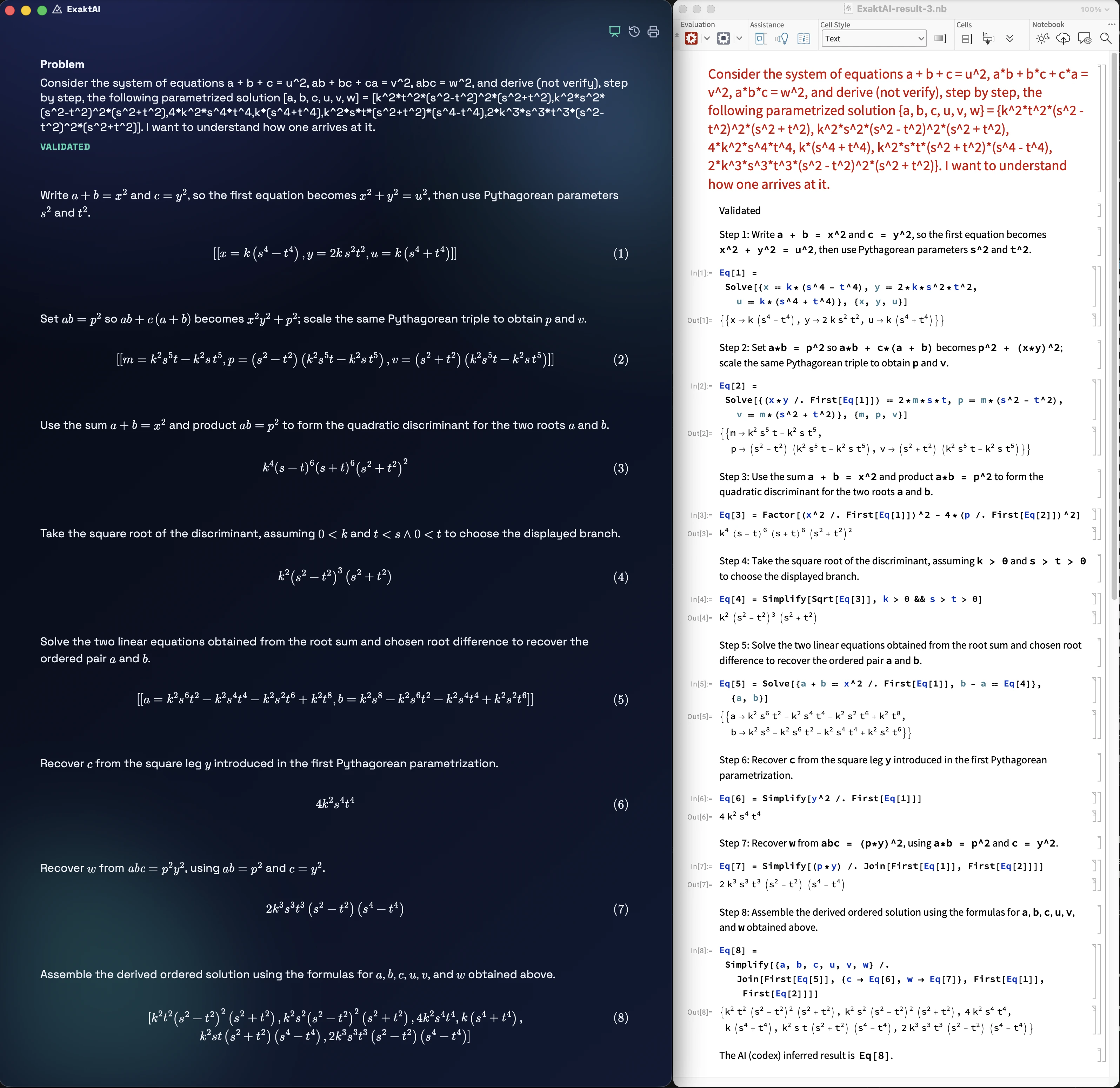
ExaktAI builds the solution from the equations. It writes a + b = x² and c = y², recognizes a Pythagorean structure x² + y² = u² and parametrizes the triple; treats v² as a second Pythagorean relation; forms the quadratic discriminant whose roots are a and b; takes its square root on a stated branch; solves the two linear equations for a and b; recovers c and w; and assembles [a, b, c, u, v, w].
Every line is a reproducible Mathematica input/output, each step references the results of the steps before it, and the final output is the requested derivation, validated.
Wolfram’s 14.3 AI Assistant*: not a derivation
The same problem asking for a derivation step-by-step to the Notebook Assistant in Mathematica 14.3, AI model ‘Wolfram’ (the default), persona Code Assistant.
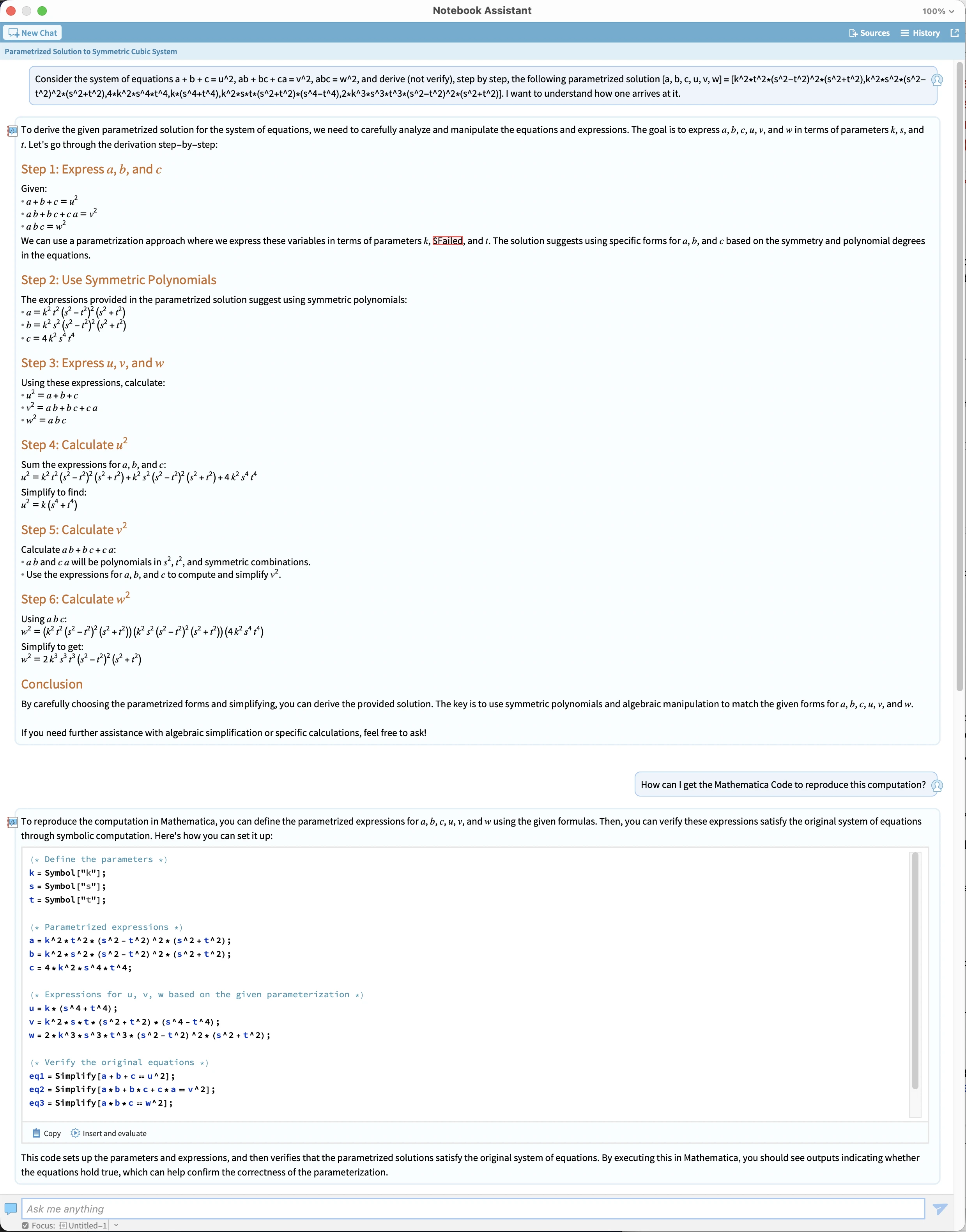
In the run shown:
- Step 1 restates the system, and the parameter s renders as “SFailed”, apparently a formatting error.
- Step 2 has an insight (use symmetric polynomials), but the specific forms written for a, b, and c are not derived; they are the given parametrized solution reintroduced.
- Step 3 rewrites the original equations with left- and right-hand sides swapped.
- Step 4 presents u² = k(s⁴+t⁴). Correct is u² = k²(s⁴+t⁴)².
- Step 5 does not compute v². It only states that the terms “will be polynomials… compute and simplify.”
- Step 6 presents w² = 2k³s³t³(s²−t²)²(s²+t²). Correct is w² = 4k⁶s⁶t⁶(s²−t²)⁴(s²+t²)².
The AI narrative does not derive the parametrized solution and gives incorrect intermediate computations. The issue is not with Mathematica's computational capabilities but with presenting an AI narrative without validating it first.
ExaktAI: an alternative, equivalent derivation
ExaktAI with Codex as the AI and Maple 2026.1 as the CAS validating tool, producing an alternative derivation in 13 steps. For presentation purposes here, ExaktAI Validation (left) shows the Problem and steps 1 to 6 out of the 13 it holds, and the Maple document ExaktAI generated (right) shows the remaining steps 7 to 13, to display the 13 steps legibly in one image.
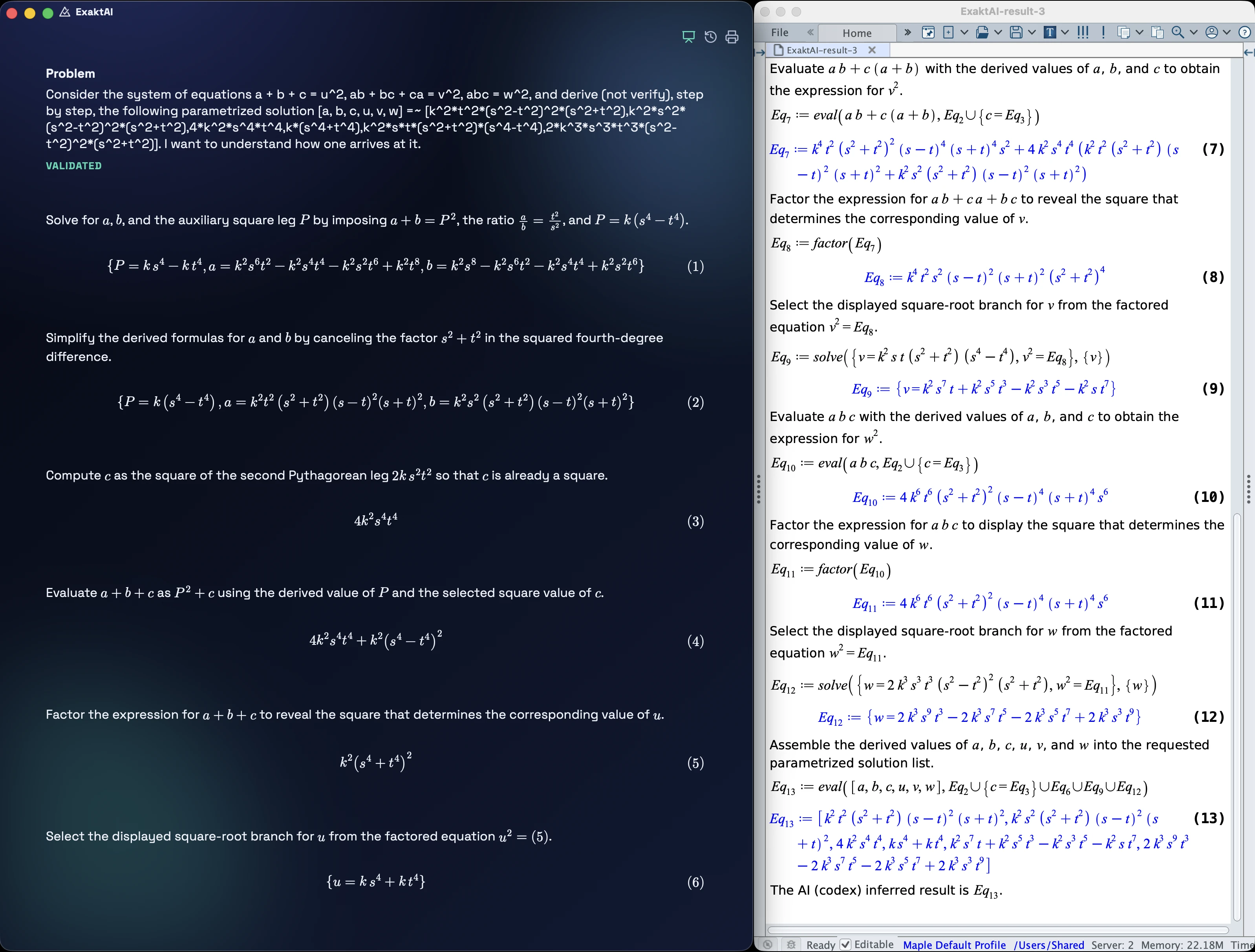
Every step is an executed Maple instruction with an output, each referencing the results of the steps before it, the whole derivation marked Validated, and the final output is the requested derivation. As with the case of the Mathematica run, the derivation is reproducible in this case by running the Maple document.
Maple’s 2026.1 AI Assistant*: a narrative, not a computable derivation
Asking the problem to Maple’s AI Assistant in Maple 2026.1, the AI states the steps, not the Maple commands that derive them sequentially.
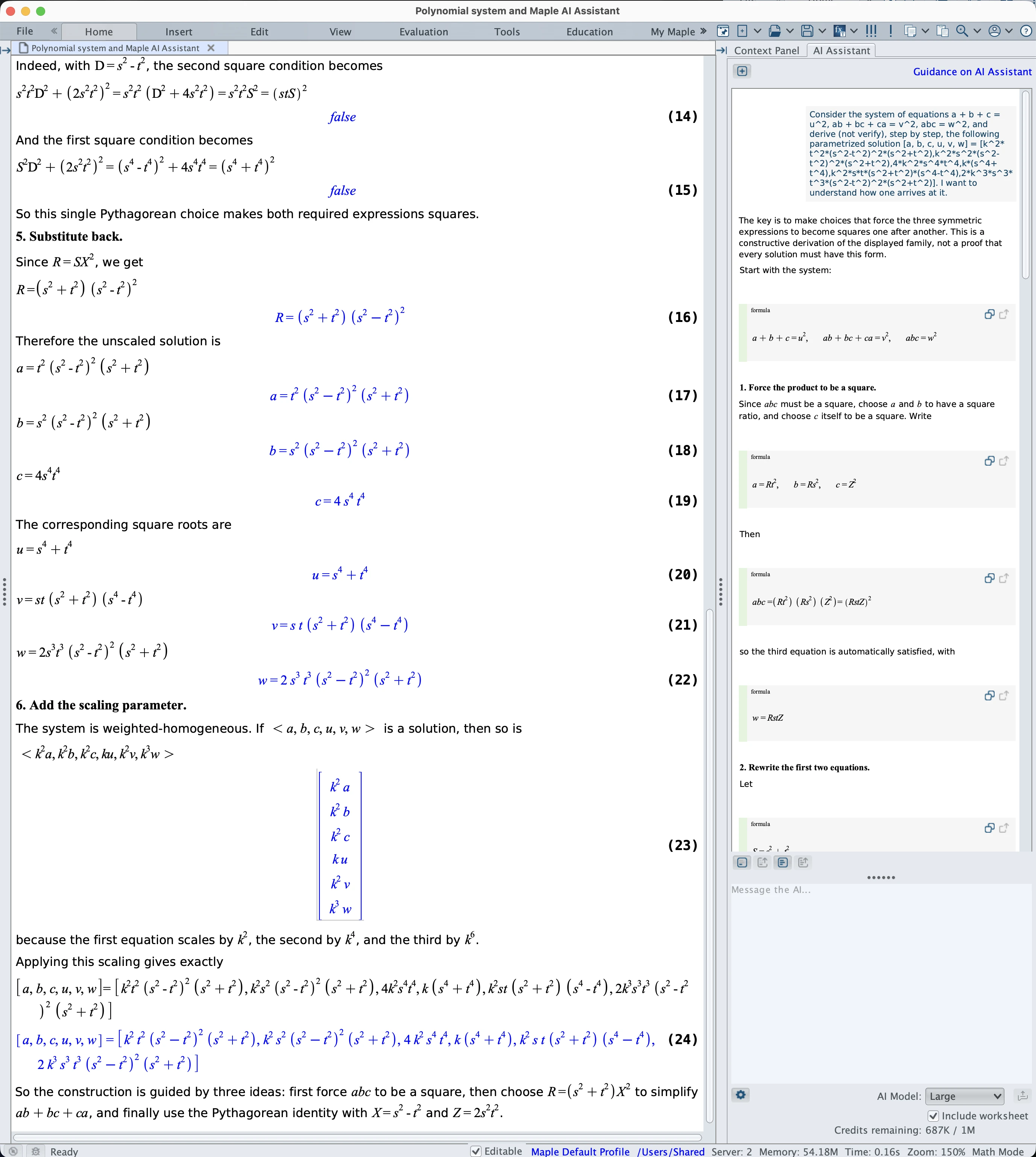
In the run shown:
- several inserted equalities evaluate to
false(lines 14 and 15 here, and earlier at 3, 6, 7). - earlier in the worksheet, a square placeholder renders as the literal text “EmptySmallSquare” (line 11).
In this case, an AI narrative of a derivation is presented, but the code supposed to compute the steps of that narrative is not given, the results of each AI reasoned step are only stated, and several using wrong syntax, producing unexpected Maple output.
The difference
Mapping all the AI reasoned steps into a chained sequence of CAS computations allows for reproducibility and validation, which are what set ExaktAI apart from CAS with AI Assistants, and are the basis for you to be in command of the computation, harness AI’s mathematical inference, and trust its results.
* These are single runs of non-deterministic AI assistants (in Mathematica 14.3 and Maple 2026.1); another run might decompose or err differently. The two CAS assistants also differed from each other here: the Notebook Assistant restated the supplied answer and its narrated steps carried errors, whereas Maple’s AI Assistant produced an AI narrative of a derivation but the code supposed to compute the steps of that narrative is not given, the results of each AI reasoned step are only stated, some using wrong syntax. Both software platforms and their AI assistants are actively evolving; the observations describe what each system produced in these specific runs. ↩ ↩