
What validation adds
In ExaktAI, validation adds trust (see AI math reliability). It turns AI-generated mathematics into a compact checked answer and, if you want one, an auditable executable document: a Maple document, a Mathematica notebook, or an ExaktAI Workspace document computed with SymPy, which needs no CAS licence.
Trustworthy in a specific sense
ExaktAI's proposition is not that it is smarter than other AI systems. It is that its results are trustworthy in a specific and reproducible sense: they are validated through a blended strategy, and delivered in an executable document familiar to the mathematical community.
ExaktAI infers, computes, and validates. It blends multiple AIs and Computer Algebra System (CAS) computations into an orchestrated conversation. It is a trust architecture with an AI-native entry point and a reproducible validated narrative as the outcome.
A validated step, expanded
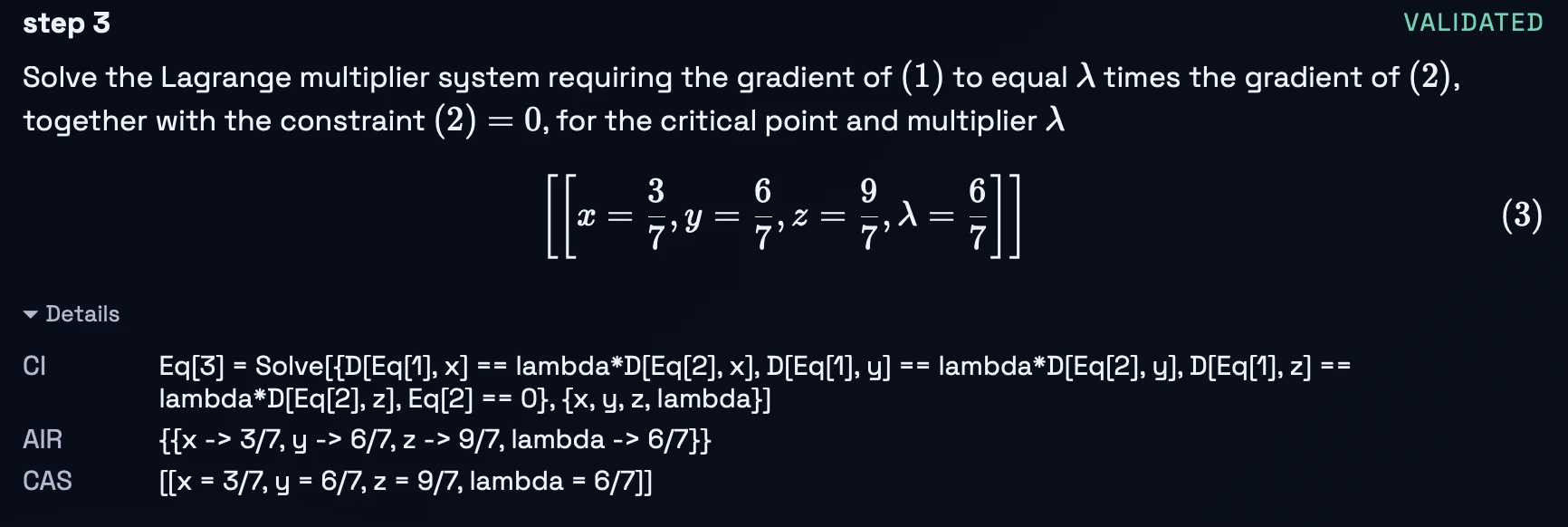
Every step carries its status inside the ExaktAI Validation window itself, and expanding one shows the computational instruction (CI), the CAS result, and the AI-inferred result (AIR).
When the CAS does not confirm†
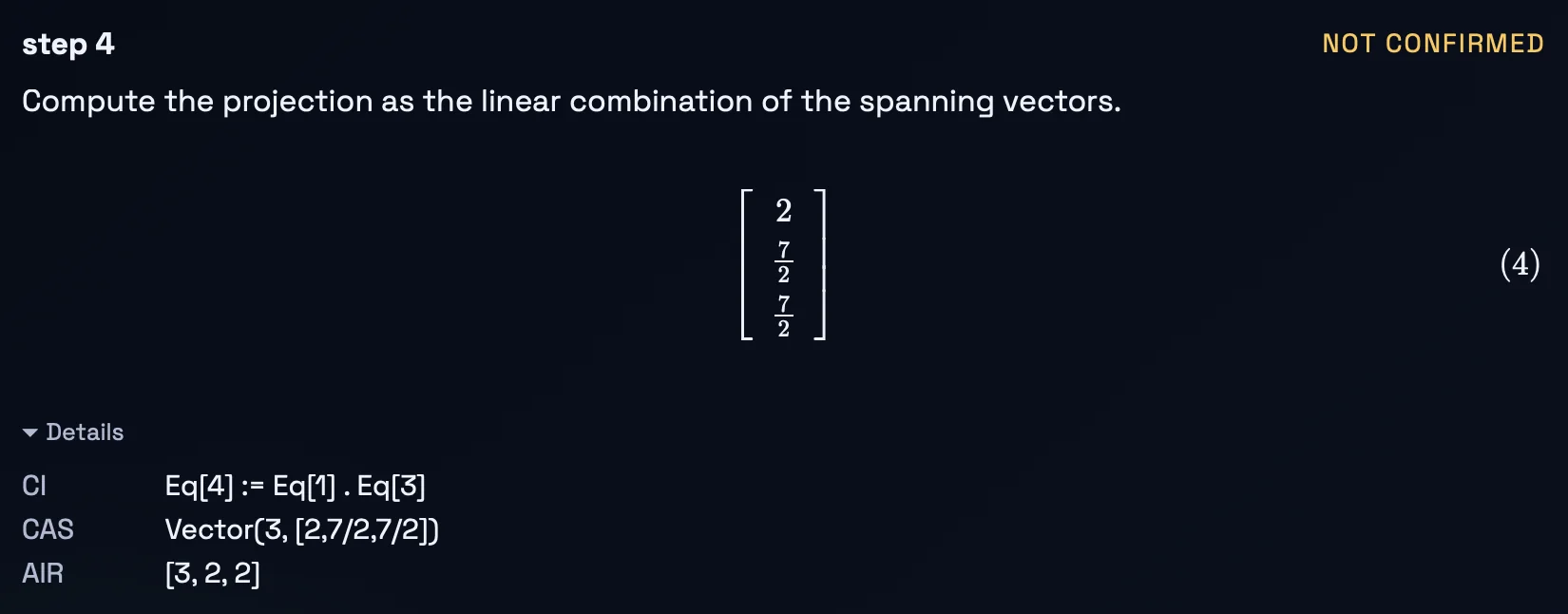
A step the CAS did not confirm. Grok with Maple: the AI inferred [3, 2, 2] for the projection, Maple computed [2, 7/2, 7/2]. The step’s Details carry both. The validation document is where you reproduce those steps and take the work further.
The validation document
The result is reproducible in a live document that opens in Maple, in Mathematica, or in the ExaktAI Workspace. Every step can be re-run with Maple, Mathematica or SymPy, which is distributed within the Workspace.

† The run shown in the figures above was performed on 13 August 2026, with Grok and Maple. AI systems are actively evolving, so the capture is a snapshot of that day. ↩